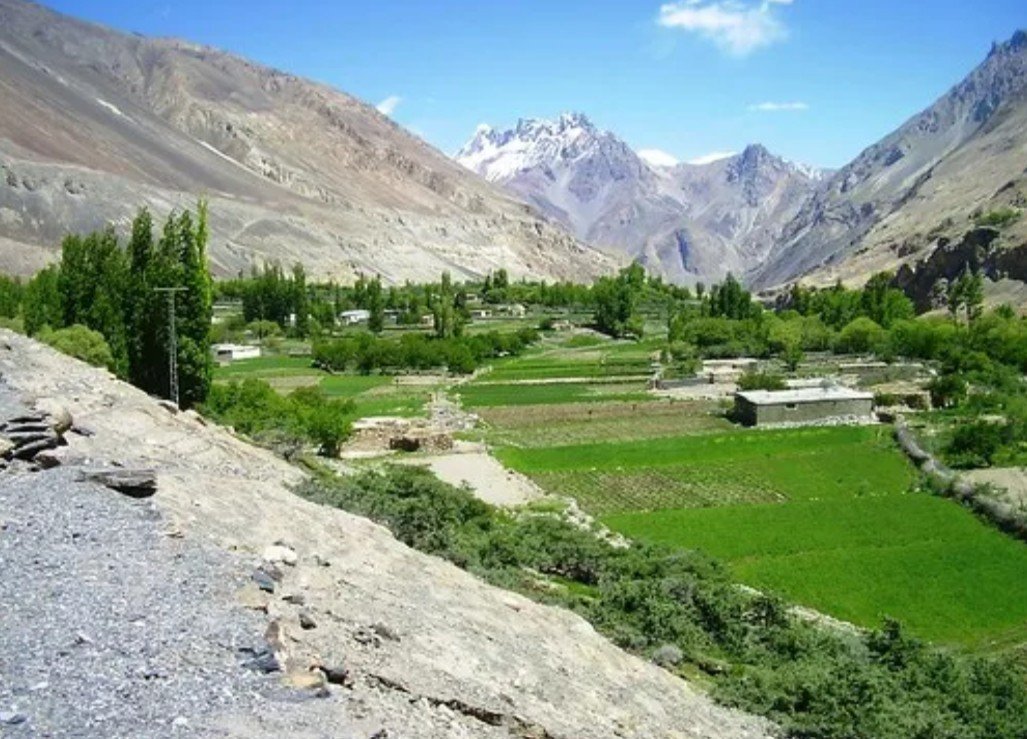
Misgar Valley
Latitude: 36.78799481 Longitude: 74.76738524
Misgar Valley – Hunza’s Northern Edge of History
Where Misgar Valley Is
Misgar Valley lies in the far northern reaches of Hunza (Gojal) in Gilgit-Baltistan, Pakistan. The valley stretches toward the borders of China and Afghanistan, making it one of the most geographically sensitive and historically significant areas of the region. Reached by a road from Gulmit off the Karakoram Highway, Misgar feels wide, quiet, and exposed—more open than most Hunza valleys.
This is a land shaped by borders, wind, and time.
A Valley at the Crossroads of Empires
For centuries, Misgar Valley stood along ancient routes connecting Central Asia, Xinjiang, and the Wakhan Corridor. Traders, envoys, and armies once passed through nearby high mountain passes such as Mintaka and Kilik, making Misgar an important frontier settlement.
Because of this position, Misgar was never just a village—it was a watchpost of Hunza. Local communities lived with constant awareness of movement beyond the mountains, shaping a culture that valued vigilance, cooperation, and resilience.
People and Cultural Identity
Misgar is primarily inhabited by the Wakhi people, whose language, traditions, and social systems remain strong despite the valley’s isolation.
Life here has traditionally revolved around:
-
High-altitude farming and grazing
-
Seasonal livestock movement
-
Community labor and shared responsibility
For anthropologists and cultural researchers, Misgar offers a clear example of how borderland identity forms—neither isolated nor fully open, but always aware of the wider world.
Historical and Research Significance
Misgar Valley is valuable for understanding:
-
Pre-modern trade networks of the Karakoram
-
Frontier defense systems of Hunza
-
Human adaptation to high-altitude plains
-
The impact of modern borders on traditional movement
Unlike more tourist-oriented valleys, Misgar retains a raw historical character that has changed little over generations.
Experiences for Visitors
Village Walks
Slow walks through Misgar reveal stone houses, open fields, and a rhythm of life closely tied to weather and seasons.
Landscape & Silence
The valley’s wide plains and open skies create a rare sense of space and quiet.
Cultural Exchange
Time spent with locals—often over tea—offers stories of migration, trade, and survival that are not written in guidebooks.
Photography
Misgar’s minimalism—earth tones, clouds, and distant peaks—appeals to photographers seeking authenticity.
How to Reach Misgar Valley
-
Travel on the Karakoram Highway to Gulmit
-
Take the road toward Misgar Valley
-
The drive is scenic but remote
Road conditions vary by season, so updated local advice is essential.
Accommodation
Accommodation is limited and community-based:
-
Homestays and small guesthouses
-
Basic facilities suited for cold nights
-
Local food prepared from seasonal produce
Staying here directly supports the valley’s residents.
Tips for Visitors
-
Best season: June to September
-
Carry warm clothing even in summer
-
Respect local customs and border sensitivities
-
Travel with patience—Misgar is not a rushed destination
-
Bring cash and essentials; shops are limited
Why Misgar Valley Matters
Misgar Valley is not defined by dramatic peaks or crowded viewpoints. Its importance lies in its quiet strength—as a frontier, a cultural bridge, and a reminder of how communities survive at the edges of empires.
For travelers who value history, space, and authenticity, Misgar offers something increasingly rare: a place that has not learned to perform for visitors.