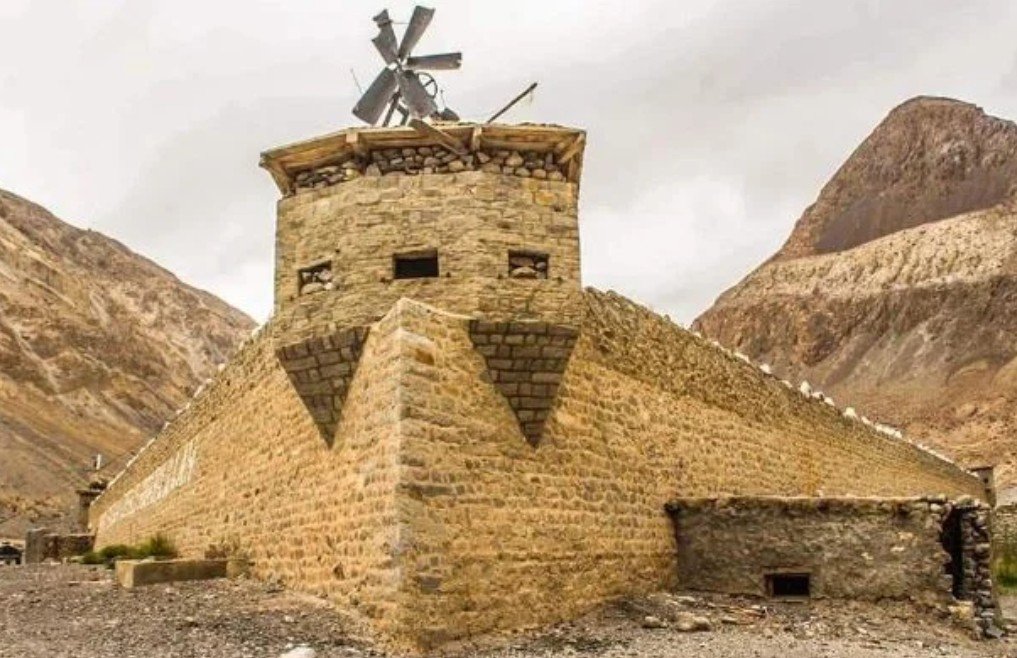
Kalam Darchi Fort
Latitude: 36.81942879 Longitude: 74.71134801
Kalam Darchi Fort – Hunza’s Silent Frontier Guard
Where Kalam Darchi Fort Stands
Kalam Darchi
Fort (also
spelled Qalamdarchi) stands on a rocky ridge overlooking Misgar
Valley in Upper Hunza (Gojal), Gilgit-Baltistan. From its elevated
position, the fort commands wide views of the surrounding plains and mountain
corridors leading toward the Mintaka and Kilik passes—routes that once
connected Hunza with Central Asia and China.
Its location
alone explains its purpose.
Historical Background
Kalam Darchi
Fort was built as a defensive and surveillance post during a period when
Hunza functioned as a frontier state. The valley below was vulnerable to
incursions, trade caravans, and military movement from the north, making early
warning systems essential.
Rather than
a palace or residential fort, Kalam Darchi was designed for observation, control,
and defense. It formed part of a wider network of watchpoints that
protected Hunza’s northern approaches long before modern borders were drawn.
During the
18th and 19th centuries—especially amid regional power struggles often
associated with the Great Game—the fort gained greater strategic
importance as outside empires sought access to the Karakoram region.
Architectural Character
Today, Kalam
Darchi Fort survives in ruins, but its structure still speaks clearly:
- Thick stone walls built from
local rock
- Narrow lookout points
positioned for visibility
- A layout adapted to steep
terrain rather than comfort
The fort’s
construction reflects mountain military architecture—functional, minimal, and
entirely shaped by geography.
Historical and Research Importance
For
historians and researchers, Kalam Darchi Fort offers insight into:
- Frontier defense strategies of
Hunza
- Pre-modern military
architecture in high mountains
- Control of trade and movement
along ancient routes
- The political role of Hunza
between larger regional powers
Its value
lies not in ornamentation, but in strategic logic.
Visiting the Fort Today
Reaching the
ruins involves a short hike from Misgar Valley. Standing among the remaining
walls, visitors are rewarded with:
- Sweeping views of the valley
and distant peaks
- A sense of isolation and
silence
- A powerful connection to the
region’s defensive past
There are no
signs or restoration efforts—what you see is raw history.
Tips for Visitors
- Visit during daylight hours
for safety
- Wear sturdy footwear; terrain
is rocky
- Avoid climbing unstable walls
- Respect the site—do not remove
stones or artifacts
- Hire a local guide to
better understand the fort’s story
Why Kalam Darchi Fort Matters
Kalam Darchi
Fort is not a monument of grandeur—it is a monument of awareness. Built
to watch, warn, and protect, it represents a time when survival depended on
reading the land and anticipating movement beyond the horizon.
In its
silence, the fort reminds visitors that Hunza’s history was shaped as much by
vigilance as by mountains.