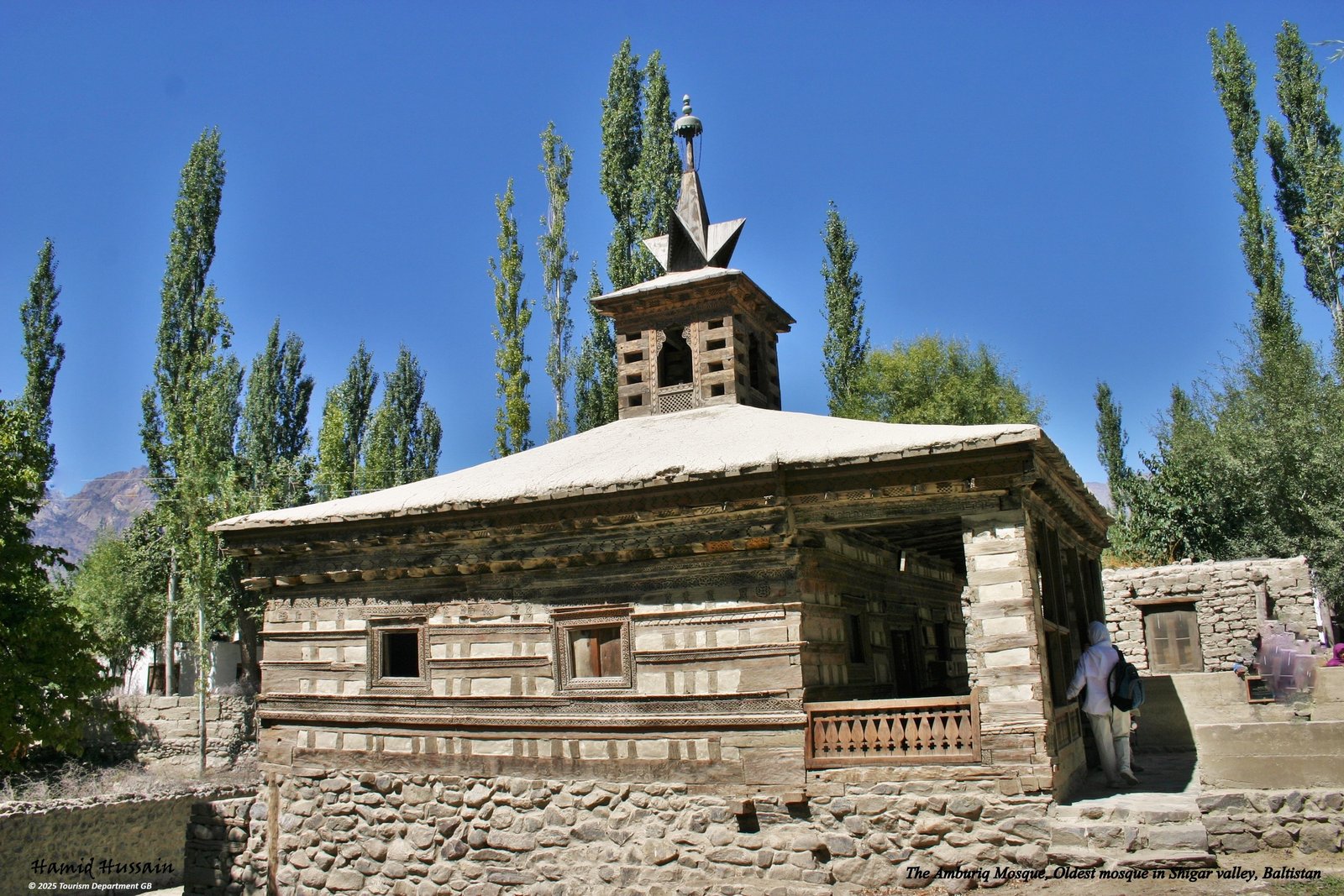
Amburiq Mosque
Latitude: 35.41345337 Longitude: 75.73997696
Amburiq
Mosque, Shigar
Hidden in the
breathtaking Shigar Valley of Gilgit-Baltistan,
Pakistan, lies a gem of spiritual and architectural heritage — the Amburiq
Mosque. Also spelled Amburik Masjid, this 700-year-old
mosque is not merely a place of worship; it is a living testament to the
region's rich history, cultural fusion, and masterful craftsmanship.
A Mosque Born from Faith and Journey
The story of Amburiq Mosque
begins in the 14th century with Sayed
Ali Hamdani (also known as Shah Hamdan), a revered
Muslim saint and missionary from Persia (modern-day Iran). During his travels
through the mountainous regions of Kashmir and Baltistan, he preached the
message of Islam. Legend has it that upon arriving in Shigar, he miraculously
caused a piece of wood to float upstream in the Shigar River — a sign that led
the local ruler (the Raja of Shigar) to embrace Islam and
grant land for the first mosque in the region.
The mosque was built under the
saint's supervision, combining Islamic spiritual principles with local building
techniques. Over seven centuries later, it still stands — prayed in, preserved,
and protected.
Architecture: Where Tibet Meets Islam
What makes Amburiq Mosque truly
unique is its architectural style — a rare and
beautiful fusion of Tibetan and Islamic design.
Unlike conventional domed
mosques, Amburiq is a wooden structure built in the
traditional Tibetan "fort-monastery" style. Key
features include:
Intricately carved
wooden pillars and beams —
displaying floral and geometric patterns inspired by both Buddhist and Islamic
art
Multi-tiered,
pagoda-like roofs —
reminiscent of Tibetan Buddhist monasteries (gomphas)
No dome or minaret — instead, a simple prayer hall with mihrab (prayer
niche) facing Mecca
Organic integration
with the landscape — the
mosque appears to grow naturally from the rocky terrain
The building materials were
sourced locally — stone for the base, and juniper and poplar wood for the
superstructure. The woodwork is entirely hand-carved, with joints fitted so
precisely that no nails were used in the original
construction.
Recognition and Preservation
In 2005,
Amburiq Mosque received the prestigious UNESCO Asia-Pacific
Heritage Award for cultural heritage conservation. This award
recognized the successful restoration of the mosque carried out by the Aga
Khan Cultural Service Pakistan (AKCSP) in collaboration with
local communities.
Inside the mosque, a
small museum now educates visitors about:
The life of Sayed Ali Hamdani
The mosque's restoration
process
The unique Noorbakshia Islamic
tradition followed in Baltistan
Despite the restoration, the
mosque's spiritual character remains intact. It continues to serve the Noorbakshia
community as an active place for daily prayers.
Setting: The Jewel of Shigar Valley
Amburiq Mosque sits at an
elevation of approximately 2,300 meters (7,500 feet) ,
surrounded by the Karakoram mountain range — home to
some of the world's highest peaks, including K2 (distant but visible on clear
days).
The Shigar River flows nearby,
and the valley is dotted with:
Apricot and cherry orchards
Traditional stone-and-wood
Balti houses
Irrigated terraced fields
The mosque's setting is peaceful
and almost timeless — a place where the sound of prayer echoes softly against
the backdrop of snow-dusted peaks.
Why Visit Amburiq Mosque?
For the curious traveler,
Amburiq offers more than religious history. It offers:
A window into
pre-Mughal Islamic history in
South Asia
A rare example of
Buddhist-Islamic architectural synthesis
An authentic,
non-commercial experience —
unlike crowded tourist sites
A gateway to exploring
the larger Shigar and Skardu region,
including the nearby Shigar Fort (Fong-Khar), Sarfaranga Cold Desert, and the
pristine Deosai Plains
Whether you are a heritage
enthusiast, a photographer, a spiritual seeker, or an adventurer tracing
ancient trade routes, Amburiq Mosque rewards your journey with beauty, peace,
and a story few places on Earth can tell.
In short:
Amburiq Mosque is not just a destination — it is a 700-year-old conversation
between mountains, cultures, and faiths. And it is still speaking to those who
listen.